Banner for the If AI Was McDonald's insight article.

If AI Was McDonald's

AI tools look confusing because they use different names for pieces that belong to the same production system: Projects, Custom GPTs, Custom Agents, Skills, etc. Let's compare these with how McDonald's creates BigMacs?

In-Short

Core Idea

Think of AI like McDonald's producing burgers on a conveyor. Every burger looks the same because the system is organized: recipe, tools, workers, and process. AI content can work the same way. Ideas, analysis, or reports can be boxed, shaped, and delivered consistently. What is the Big Mac in AI? And who is Mr. Ronald McDonald?

Why It Matters

Understanding these layers saves time.

It becomes easier to:

  • produce consistent, good-looking outputs
  • maintain quality across content or workflows
  • avoid rebuilding the same logic

The result is reliable AI production instead of random prompts.

What's on the plate?

Think of the AI ecosystem like a menu where each component has a clear role.

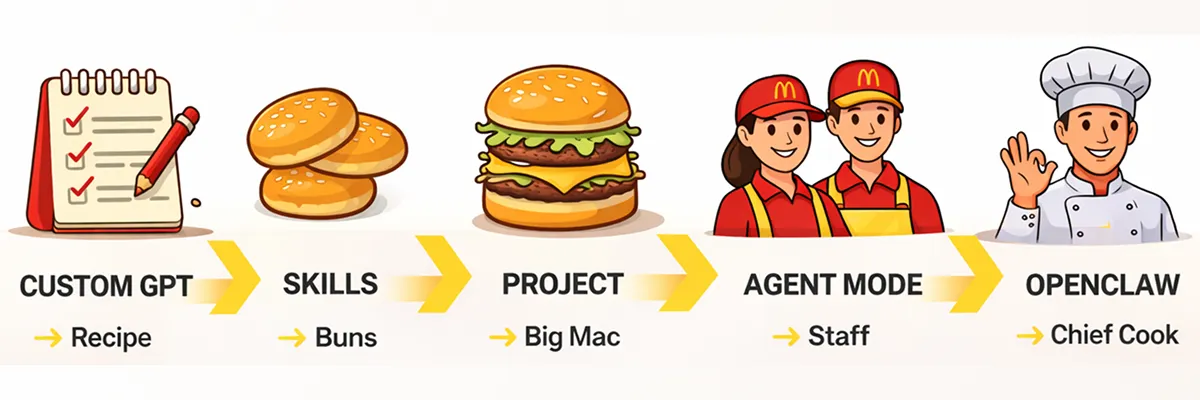
  • Projects - workspace where context and files live
  • Custom GPTs - recipe defining the output
  • Skills - reusable building blocks used across outputs
  • Agent Mode - worker executing tasks
  • OpenClaw / Perplexity Computer - AI that can operate a computer directly

Each piece solves a different operational problem.

Simple Way to Imagine It

The McDonald's analogy maps directly to AI systems.

  • Big Mac -> Custom GPT (recipe defining the output)
  • Staff -> Agent Mode (workers assembling the output)
  • Conveyor -> automation workflows like n8n or Make
  • Kitchen -> Project (context, files, and instructions)
  • Buns / ingredients -> Skills (reusable building blocks used repeatedly)
  • Freelance cook -> OpenClaw / Perplexity Computer

Skills behave like standardized ingredients.

Each time you make a Big Mac, you use the same bun. Each time you build something like a website footer, you can call the same Skill to get the same structure.

The recipe may change. The burger may change. But the ingredient stays consistent.

How it works in practice

Long Read

Modern AI systems work much closer to structured production than most people realize.

Take McDonald's. A Big Mac is not produced by one creative chef improvising every time. The burger exists because the system separates responsibilities. There is a recipe that defines the burger. There are workers who assemble it. There are tools and ingredients used repeatedly. And there is a production line that ensures consistency.

AI systems are evolving in the same direction.

A Project acts like the kitchen. It stores context, documents, conversations, and instructions. Without that environment, outputs quickly become inconsistent because the AI has no shared memory of how work should be done.

Inside that environment sits the recipe, which is where Custom GPTs come in. A Custom GPT defines tone, structure, and rules. It describes what the final output should look like and how the system should behave.

But recipes alone do nothing.

Execution happens through Agent Mode. Agents can gather information, follow steps, and decide what the next action should be. Instead of responding to a single prompt, they can run a sequence of tasks until the final result is ready.

Agents become much more powerful when they can use Skills. Skills are reusable building blocks that perform specific operations such as searching, analyzing documents, or generating structured sections of content. They allow the system to reuse the same reliable components again and again.

Recently another category appeared: computer-using AI. Tools like Perplexity Computer allow AI to operate interfaces directly by opening websites, clicking buttons, or navigating software. Projects like OpenClaw attempt to make this model safer and more controlled.

A simple example from my own work illustrates this.

When I built the landing page for portal.magicbetting.be, I used Agent Mode to review the live website. The agent scanned the page, analyzed the content structure, and pointed out SEO and mobile responsiveness issues that were easy to miss during development.

The Project stored the context of the site. The GPT defined how the analysis should be performed. The agent executed the review. Skills helped perform the checks.

That workflow looked less like asking an AI question and more like running a small production system.

And that is the real mental model.

AI is not one tool doing everything. It is a structured environment where recipes, workers, ingredients, and production lines combine to deliver consistent results.